Bangkok airport maps — Suvarnabhumi floor plan + Don Mueang layout
These Bangkok airport maps show where to go at Suvarnabhumi (BKK) and Don Mueang (DMK). At BKK, public arrivals are on Level 2, taxis on Level 1 and Airport Rail Link on B1. At DMK, Terminal 1 serves international flights and Terminal 2 serves domestic flights; both public arrivals halls are on Level 1. Choose your airport and destination in the map, then use the floor plans, signs and directions to find your next stop.
Explore the airport mapsFind your airport, floor and onward transport
At Suvarnabhumi (BKK), arrivals are on 2F, Airport Rail Link is on B1, public taxis and buses are on 1F, restaurants and shops are on 3F, and departures are on 4F.
At Don Mueang (DMK), T1 serves international flights and T2 domestic flights. Public arrivals are on 1F, check-in is on 3F, and the station connection is reached from T2 on 2F. The public T1 ↔ T2 connections shown here are on 1F, 3F and 4F.
Official BKK airport map · Official DMK airport map
Loading the interactive airport map…
01Suvarnabhumi (BKK) — the floors you need
The Suvarnabhumi floor plan is easiest to read by choosing a level first. The map above covers the main terminal's five principal public levels, from B1 to Level 4.
- B1 — Airport Rail Link: the station for the train into Bangkok.
- Level 1 — ground transport: public taxis, the S1 city bus and selected intercity coach services.
- Level 2 — arrivals: the public hall reached after baggage collection and the required arrival checks.
- Level 3 — restaurants and shops: a useful place to look for a meal in the public terminal.
- Level 4 — departures: airline check-in and the start of the departure process.
For example, going from arrivals to the city train means going down to B1. Going to check-in means going up to Level 4. Follow the destination signs to a suitable lift or escalator; the map does not identify your exact position inside the building. The official Suvarnabhumi airport map has the airport's full facility directory.
02Departing from BKK — check-in to gate, step by step
- Main check-in hallThis pin marks an example counter island on Level 4. Check the departure screens for your flight’s assigned row, then follow the large row letters.
Start at Level 4 departures in the main terminal. If you arrive by train at B1, follow Departures / Check-in signs upstairs. If someone drops you off by road, confirm the departure level with the driver.
- Read the departures screen for your flight number and check-in row.
- Complete your airline's check-in and baggage-drop requirements.
- Follow the signs for the correct domestic or international departure process.
- After the required checks, follow your boarding-gate signs and watch for updates on the screens.
Use your airline's check-in deadline and boarding time when planning your arrival. A marker on this map identifies the check-in area; it cannot tell you which counter is operating for your flight today.
03Finding your airline's check-in counter at BKK
- Example counter islandThe letters on the plan identify check-in rows. Match the row to your flight on the departure screens; the pin is not a fixed airline assignment.
The lettered check-in rows are useful landmarks on the Level 4 map. Your flight number is the detail that connects that plan to the counter you actually need.
Find the flight number on a departure screen, read its counter or row assignment, and then look for the large row letter above the counters. Check the screen again if the counter has not opened or the row appears to serve a different flight. Airline allocations can change, so do not use a remembered airline-to-row list as your final instruction.
A terminal entrance number, a check-in row and a boarding gate describe three different places. Keep all three in your message if you are arranging to meet someone before departure.
04Arriving at BKK — from the aircraft to the public hall
- Door 1 · Arrivals levelA numbered terminal exit on Level 2. When meeting someone, confirm the floor as well as the door number.
- Door 3 · Inter-airport shuttleThe shuttle to Don Mueang uses the inner curb outside this Level 2 door. Connecting-flight proof and identification are required.
- Door 7 · Check the floorThis is Door 7 on Level 2. The S1 city bus uses Door 7 on Level 1, one floor below.
Follow Arrivals signs from your aircraft. International passengers complete the required entry checks, collect checked baggage and pass through the appropriate customs channel before reaching the public arrivals hall on Level 2. Domestic arrivals also reach the public hall on Level 2 after baggage collection.
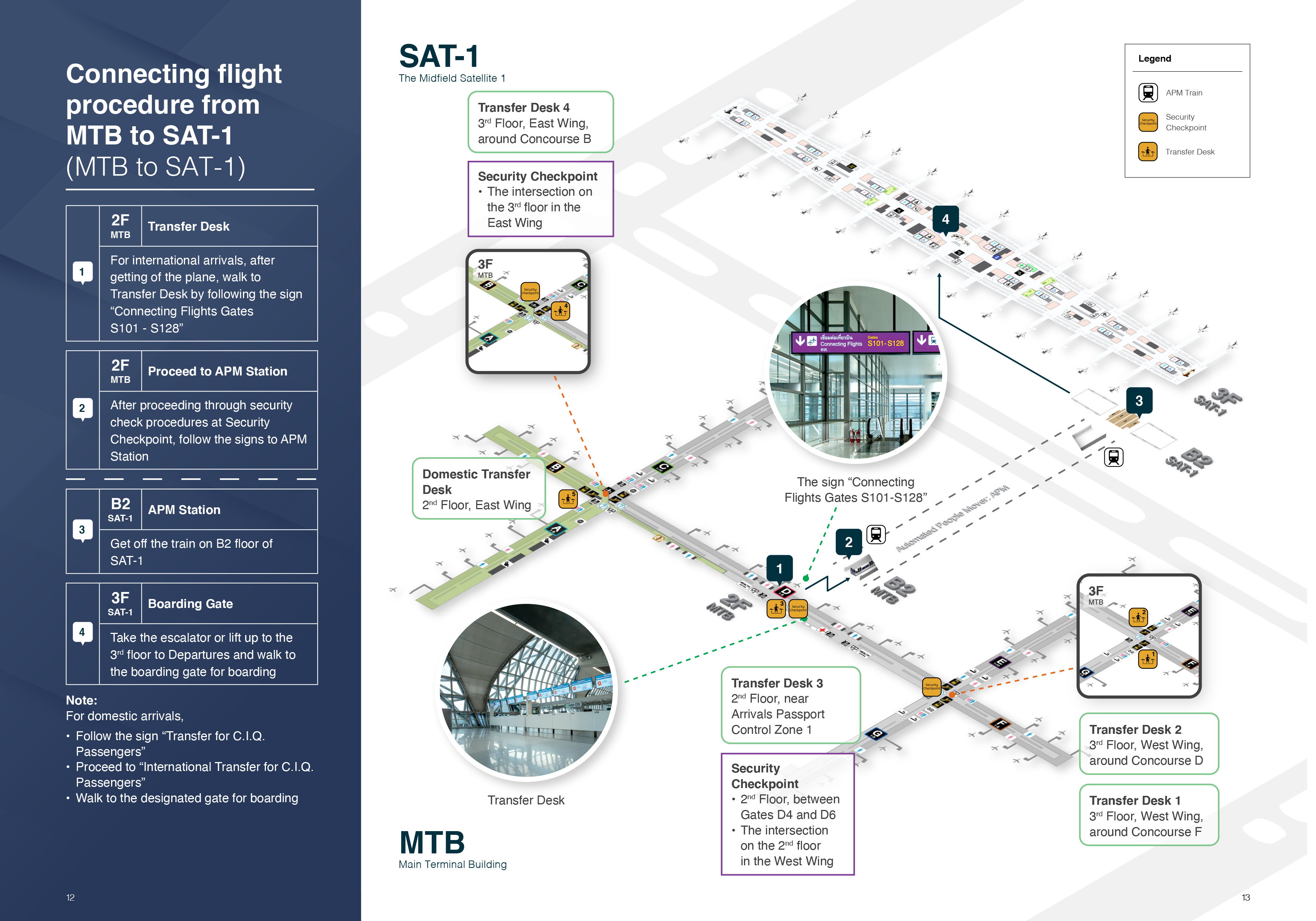
If your aircraft arrives at SAT-1, follow the airport's arrivals route and APM signs back to the main terminal. If you are connecting to another flight, follow the transfer instructions for your ticket instead of automatically leaving for the public hall.
The walking directions in this map start on the public side. Once you are there, choose Airport Rail Link, Public taxi, a bus service, restaurants or check-in. For photographs of the public arrivals route and meeting arrangements, see the BKK arrival pickup guide.
05BKK transport map — rail, taxi, city bus and coaches
- Public taxi · Doors 4–7The C4 area is labelled Taxi Service on the AOT plan. Go outside between Doors 4 and 7, take an official queue ticket and follow the staff’s instructions.
- S1 city bus · Door 7Exit at Door 7 on Level 1 and look for S1 at the inner curb. Check the bus destination before boarding.
- Intercity coaches · Door 8Look for the coach counters in the Door 8 area. Confirm your destination and boarding point with the operator; some services use the separate Public Transportation Center.
From the Level 2 arrivals hall, match the transport name to its level before heading outside.
- Airport Rail Link — B1: follow the train signs down to the station, choose your destination and buy the appropriate ticket before entering the platforms.
- Public taxi — Level 1: follow Public Taxi signs to the official queue-ticket area. AOT lists it between terminal Doors 4 and 7. Take a queue ticket and follow the staff's instructions.
- S1 city bus — Level 1, Door 7: look for S1 at the inner curb for the Khao San Road / Sanam Luang service.
- Selected intercity coaches — Level 1, Door 8: confirm your destination and boarding point with the coach operator. Other services use the separate Public Transportation Center.
- Shuttle to Don Mueang — Level 2, Door 3: this is for passengers connecting between the two airports. Have proof of your onward flight and identification ready.
Locations and operating details are listed in AOT's Suvarnabhumi transport guide. For fares, use the Bangkok airport taxi prices guide; for transport choices and pre-arranged pickups, see the Bangkok airport transfer guide.
06Suvarnabhumi concourses and SAT-1 — finding your boarding gate
A boarding gate is beyond the passenger checks; a numbered terminal door opens onto a public hall or curb. The door numbers used for taxis and buses are not aircraft boarding gates.
For a gate in concourses A–G, follow the letter and number shown on your boarding pass and the latest flight-information screen. For SAT-1 gates S101–S128, follow the SAT-1 / APM signs after completing the required departure checks in the main terminal. The APM carries passengers between the main terminal and SAT-1.
The APM is separate from the Airport Rail Link to Bangkok. This page's public-terminal map helps you reach check-in and ground transport; it is not a complete airside gate-routing map. AOT publishes separate SAT-1 connection instructions.
07Don Mueang Terminal 1 — the international terminal, floor by floor
- Example arrivals exitExit into the T1 public arrivals hall after immigration, baggage collection and customs. This arrow marks one example exit on the plan.
- Toward Terminal 2The blue arrow on the AOT plan points toward T2. Follow the terminal signs through the public arrivals hall on 1F.
- Example check-in islandFind your flight on the departure screens, then follow its assigned counter row. This pin shows one island, not a fixed counter for your airline.
- Toward Terminal 2The blue arrow on the AOT plan points toward T2. Follow the terminal signs through the public departure hall on 3F.
On the Don Mueang airport layout, Terminal 1 is the international terminal. Select T1 above before looking for your floor.
- Level 1: baggage claim, the public arrivals hall and ground-transport services.
- Level 2: international arrival and immigration areas. These include controlled passenger areas and are not a general public shortcut between the terminals.
- Level 3: the international check-in hall and departures process.
- Level 4: food and service areas shown on the official plan.
After an international arrival, follow the airport's sequence through entry checks and baggage collection to the public hall. From there, choose your onward transport. For another international departure, use the Level 3 check-in screens to find the current counter assignment.
08Don Mueang Terminal 2 — the domestic terminal
- Example arrivals exitExit into the T2 public arrivals hall after baggage collection. This arrow marks one example exit on the plan.
- Toward Terminal 1The blue arrow on the AOT plan points toward T1. Follow the terminal signs through the public arrivals hall on 1F.
- Example check-in islandFind your flight on the departure screens, then follow its assigned counter row. This pin shows one island, not a fixed counter for your airline.
- Toward Terminal 1The blue arrow on the AOT plan points toward T1. Follow the terminal signs through the public departure hall on 3F.
Terminal 2 serves domestic flights. Its public arrivals hall and baggage claim are on Level 1; check-in is on Level 3. Do not head to Level 3 to meet a passenger coming out after baggage collection.
Level 2 provides the signed route toward the domestic parking building and the Red Line station connection. Level 4 has food and services. The map's T1 and T2 tabs let you inspect the two buildings separately; the T1 ↔ T2 view brings their connection areas together.
For a domestic departure, first check your flight's terminal and counter on the airline information and airport screens. For a domestic arrival followed by an international flight, complete the arrival process and follow the instructions for your onward booking. Moving buildings is only one part of a flight connection.
09DMK transport map — the Red Line, public taxis and airport buses
- Train StationRead the destination and its arrow together. Follow the station signs from Terminal 2, Level 2.
- SRT Red LineThis smaller sign confirms the railway connection. The Red Line serves DMK; Airport Rail Link serves BKK.
- Queue-number displayMatch your queue ticket to the number being called, then check the counter number beside it.
- AOT Taxi Service countersUse the official taxi service area and follow the staff’s instructions. Terminal 1 has its own taxi area.
- Airport Door 6This number identifies a terminal door. It is different from Exit 6 at the railway station. Check the bus route number and destination before boarding.
For the SRT Red Line, the public route uses Terminal 2, Level 2, through the domestic parking building and the signed Sky Walk to Don Mueang station. From T1 public arrivals, first follow Terminal 2 signs through the Level 1 connection, then go up in T2 and follow Train Station / SRT Red Line signs.
The railway operator identifies station Exit 6 as the domestic-terminal connection. That is a railway-station exit number, not airport Door 6. Check the SRT Don Mueang station information for the station layout.
For a public taxi, stay on Level 1 and follow Taxi signs to your terminal's official service area. Confirm T1 or T2 in the map so you do not walk to the other building unnecessarily. For an airport bus, check the route number and destination before boarding. This map uses the confirmed service point at Terminal 1, Level 1, Door 6. Check the signs and AOT’s airport bus information before boarding.
The official Don Mueang airport map is useful for locating a nearby information counter if signs or temporary arrangements differ.
10DMK T1 ↔ T2 — where the terminals connect
- Terminal 1 connectionLevel 1 · Follow Terminal 2 signs. Stay on this floor and use the public arrivals-hall connection.
- Terminal 2 connectionLevel 1 · Follow Terminal 1 signs. Stay on this floor and use the public arrivals-hall connection.
Choose Level 1, Level 3 or Level 4 above to compare the public connections. In these pictures, point 1 marks the Terminal 1 end and point 2 marks the Terminal 2 end. The short dashed line joins the two published plans. For a journey from your chosen starting terminal, use the interactive map at the top of this page: A marks your start and B your destination, with other floors faded.
- Level 1: use the public arrivals-hall connection when moving between the terminals after collecting baggage.
- Level 3: use the connection between the public departure halls before security.
- Level 4: follow the terminal-direction signs beside the food and service areas.
The plans are joined at the terminal-direction edges shown in AOT's separate drawings. The short line between them is an illustration, not a measured corridor or a walking-time estimate. AOT also places its Lost & Found counter at the Level 3 T1–T2 interconnect.
The detailed DMK Terminal 1 to Terminal 2 guide covers flight-connection planning. The public map does not replace airline instructions for a transfer after security.
11Reading the map, recognising signs and arranging a meeting
- Terminal 2 means the buildingChoose T1 or T2 before choosing a floor. At DMK, T1 serves international flights and T2 serves domestic flights.
- Follow the direction arrowThe arrow above this corridor points onward to Terminal 2. It does not mean go up to Level 2.
- 4 · DeparturesThe large 4 is a floor number. This is the level for airline check-in.
- 2 · ArrivalsThe public arrivals hall is on Level 2. Start the public-terminal directions after the arrival checks and customs.
- B · Airport Rail LinkB on this sign means the basement. In this guide, select B1 for the Airport Rail Link station.
- Door 9 is a terminal exitThis door number is not an aircraft boarding gate. Find your boarding gate on your boarding pass and the flight screens; SAT-1 gate codes S101–S128 are explained in section 06.
Start by matching the airport code, terminal and floor to the signs around you. BKK means Suvarnabhumi; DMK means Don Mueang. In the map, A is the starting area you selected, not a live location detected from your phone. B is the destination area. Zoom in to read the original floor-plan details, or open a single floor when the stack feels too busy.
The route steps explain the level changes. Photographs, where available, help you recognise a sign or area; use their captions and the signs in front of you together. Shopfronts and temporary barriers can change. If you need a step-free route or assistance with luggage, ask an airport information counter to confirm the available lifts and path. The diagram does not certify an accessible route.
If someone is meeting you, agree on the airport, terminal, level and exact door. For arranged pickups, keep the confirmed meeting message handy. The DMK arrival pickup guide has meeting photographs; the Suvarnabhumi to Bangkok transfer and Don Mueang to Bangkok transfer pages explain the respective services.
12FAQ
- Which level do taxis leave from at Suvarnabhumi (BKK)?
- Public taxis leave from Level 1. From Level 2 arrivals, follow Public Taxi signs down to the official queue-ticket area between terminal Doors 4 and 7. These are public terminal doors, not boarding gates. Follow the taxi staff’s instructions after taking a ticket.
- Which Don Mueang terminal handles international flights?
- Terminal 1 handles international flights and Terminal 2 handles domestic flights. Both public arrivals halls are on Level 1, and both check-in halls are on Level 3. The T1 ↔ T2 map shows the public connections on Levels 1, 3 and 4.
- Where is the Fast Track / Premium Lane at Suvarnabhumi?
- Arrival Fast Track / Premium Lane is part of the immigration process before baggage collection and the public Level 2 arrivals hall. Follow the signs and the instructions for your eligible or booked service. It is not an entrance from the public hall. See the Bangkok airport Fast Track guide for more context.
Arrange your airport transfer when you are ready
SabaiRide airport transfers to Bangkok are THB 3,000, with tolls, parking, flight tracking and 60 minutes of airport waiting included. Your pickup confirmation gives the meeting details.
SabaiRide is a private Bangkok chauffeur service — flat published rates, flight tracking on every airport pickup, 24/7.