Ayutthaya is the ruined old capital of Siam, a royal city on an island where three rivers meet, about 76 km north of Bangkok in its own province. By private car, Bangkok to Ayutthaya is about 80 km by road: 60–90 minutes off-peak, 90–120 minutes in the rush hour, from your hotel door to the entrance of the historical park.
AyutthayaAncient temples, a little north of Bangkok
The drive
About 80 km by road, 60–90 minutes off-peak
The chauffeured day
Flat THB 12,000 for the whole car, home the same evening
One-way drop
Flat THB 7,000 to an Ayutthaya hotel, for staying over
The old capital
On the UNESCO World Heritage List since 1991
Start with the journey
A temple day, or a night by the river?
Choose the chauffeured temple day with the Bangkok return, a one-way drop for an overnight stay, or a different plan we quote for you.
Back the same evening
Temple day & Bangkok return
THB 12,000per private car
Bangkok pickup, driving between your agreed Ayutthaya stops, waiting during your visits and return to Bangkok that evening. Explore the temples independently; admission and meals are separate.
Quoted for your planyour stops, agreed before travel
Bang Pa-In Royal Palace, Wat Tako or Wat Satue out in the province, longer stops, a different return plan or an airport pickup on the day: send us the plan on WhatsApp or LINE before booking and we quote it separately.
Start with the drive, then follow the ruins in the old city, across the water and out in the province.
01Ayutthaya from Bangkok: the drive up
It is a drive of about 80 km, and the route barely changes: up the Don Mueang Tollway, then Asian Highway 1 straight to the ruins. Off-peak it runs 60–90 minutes, stretching to 90–120 in the rush hour; the known slow point is Vibhavadi-Rangsit by the Don Mueang exit; allow extra time on busy weekends, holidays or in heavy rain. From your hotel door the car runs straight through to the Ayutthaya historical park, and tolls and parking are part of the fare.
02The old city, across the water, out in the province — and what the car does between them
The reason a car matters here is simple: Ayutthaya's archaeological sites sit a bit too far apart to walk between, so you need wheels to go from one to the next. The car is those wheels — it carries you between the ruins you agree with us before booking and waits at each while you look around, so no part of the day is spent working out transport. Where the places stand sets the shape of the day. Most of the famous ruins stand in the old city; a second set lies across the water or at the edge of town, some with a river to cross. The day's loop is agreed from those first two groups; the three places out in the province are a separate run of their own, quoted separately and not part of that loop. One guide puts the sensible ceiling at five or six temples in a day — add a seventh, or Bang Pa-In Royal Palace, and it tips into a rushed, hot one. Another write-up calls the middle of the day, 10:00 AM to 2:00 PM, the least comfortable and the most crowded stretch at the open-air ruins, so an early start is the move, and if you want the last light at Wat Chaiwatthanaram across the river, we agree the return time with you before booking.
03Things to see in Ayutthaya, by where they stand
Ayutthaya's sights fall into three groups by where they stand. For the first two groups the car is simply your way between the places you agree with us; the three out in the province are quoted separately on WhatsApp or LINE before booking, and a boat on the river is your own booking.
In the old city: the Ayutthaya Historical Park; Wat Mahathat; Wat Ratchaburana; Wat Phra Si Sanphet; Wihan Phra Mongkhon Bophit; Wat Phra Ram; Wat Lokayasutharam, the reclining Buddha; the Ayutthaya Elephant Palace & Royal Kraal; the Ayutthaya Historical Study Center; and the Ayutthaya night market.
Across the water and at the edge of the city: Wat Chaiwatthanaram; Wat Yai Chai Mongkhon; Wat Phanan Choeng; the Japanese Village; the Ayothaya Floating Market; Wat Maheyong; Wat Phra Ngam, the gate of time; and the river around the island.
Out in the province: Bang Pa-In Royal Palace, Wat Tako and Wat Satue — three trips out of the old city rather than stops on the loop.
04Ayutthaya, the old capital of Siam
Ayutthaya was the second capital of the Siamese kingdom, founded in 1350 and a capital for 417 years, until the Burmese army destroyed it in 1767. The old city has been on the UNESCO World Heritage List since 1991. Its formal name is Phra Nakhon Si Ayutthaya, the name of both a district and a province, and the old city is an island, with three rivers around it — the Lop Buri River, the Pasak River and the Chao Phraya River, with the Lop Buri joining the Chao Phraya on the western side.
05Ayutthaya Historical Park
The Ayutthaya Historical Park is where the old city's registered monuments are looked after — the Fine Arts Department set up a project to care for and manage them. Many of the headline temples stand inside it, a drive apart rather than a walk, which is where the car earns its keep. Any entry ticket is yours to buy — we drive and wait, and sell none.
06Wat Mahathat
Wat Mahathat
Wat Mahathat is one of the ruins inside the park, in the island-like centre of the city called Ko Mueang, and it holds the sight people come to see: the head of a Buddha image grown over by tree roots. Before you photograph it, one write-up gives the rule: you crouch or kneel, since standing higher than the head is taken as disrespect, and staff hold visitors to it.
07Wat Ratchaburana
Wat Ratchaburana
Wat Ratchaburana stands north of Wat Mahathat and held the rank of a royal monastery in the Ayutthaya period, its main prang ringed by a cloister. When the crypt is open, a destination guide says you can take a narrow staircase down into the chamber for a glimpse of faded murals — it warns the steps are very steep and dark. Much of what was dug up here is now kept in the Chao Sam Phraya National Museum.
08Wat Phra Si Sanphet
Wat Phra Si Sanphet
Wat Phra Si Sanphet was the most important temple of all, inside the old royal palace — to Ayutthaya what the Temple of the Emerald Buddha is to Bangkok. Its symbol is three restored bell-shaped chedi in a row on a raised platform, which held the ashes of Ayutthaya kings. A destination guide allows 30 to 60 minutes for it.
09Wihan Phra Mongkhon Bophit
Wihan Phra Mongkhon Bophit
Wihan Phra Mongkhon Bophit stands on the south side of Wat Phra Si Sanphet and shelters Phra Mongkhon Bophit itself — a large bronze Buddha image. It is a short, worthwhile stop next door to the palace temple.
10Wat Phra Ram
Wat Phra Ram
Wat Phra Ram is an early Ayutthaya-period temple, said to stand where the funeral of the first king, U-Thong, was held, beside Bueng Phra Ram, the pond said to have been dug on his order and now laid out as a park. One write-up describes it as peaceful and shady, with a tall central prang and grass to sit on, and not as crowded as the headline temples despite being one of the most impressive.
11Wat Lokayasutharam, the reclining Buddha
Wat Lokayasutharam
Wat Lokayasutharam is a giant reclining Buddha lying out in the open in the west of Ayutthaya, north of Khun Phaen House, with no hall or building around it. It is a quick stop — visitors report no more than 15 to 20 minutes.
12Ayutthaya Elephant Palace & Royal Kraal
The Ayutthaya Elephant Palace & Royal Kraal is a working elephant camp inside the historical park, across from Khun Phaen House. The tourism authority's own listing says visitors ride around the ruins on an elephant's back, feed the elephants and take souvenir photos; a review from May 2025 is critical, describing chained elephants, shows and rides, elephants walking on asphalt amid car traffic, and the use of the hook, and urges readers not to go. Whether you visit is your call.
13Ayutthaya Historical Study Center
The Ayutthaya Historical Study Center, in Pratuchai, uses reconstructed scale models and video to lay out Ayutthaya's history and Thai culture. The newest visitor reviews we found date from 2018 — one calls it a well laid-out walk through the city's past, its people, food and boats, and reckons about 2 hours is enough — so whether it is open on your date is something we confirm with you before the day.
14Ayutthaya Night Market
Ayutthaya has an evening market, and which one is running changes — so we confirm it with you when you book: the weekend market near the tourism office is now listed as closed, and the one a review platform lists instead is Bang Lan Night Market, a street food market near Wat Mahathat that a July 2026 review calls cheap and tasty. Tell us your date on WhatsApp or LINE, and we check what is open before the drive.
15Wat Chaiwatthanaram
Wat Chaiwatthanaram
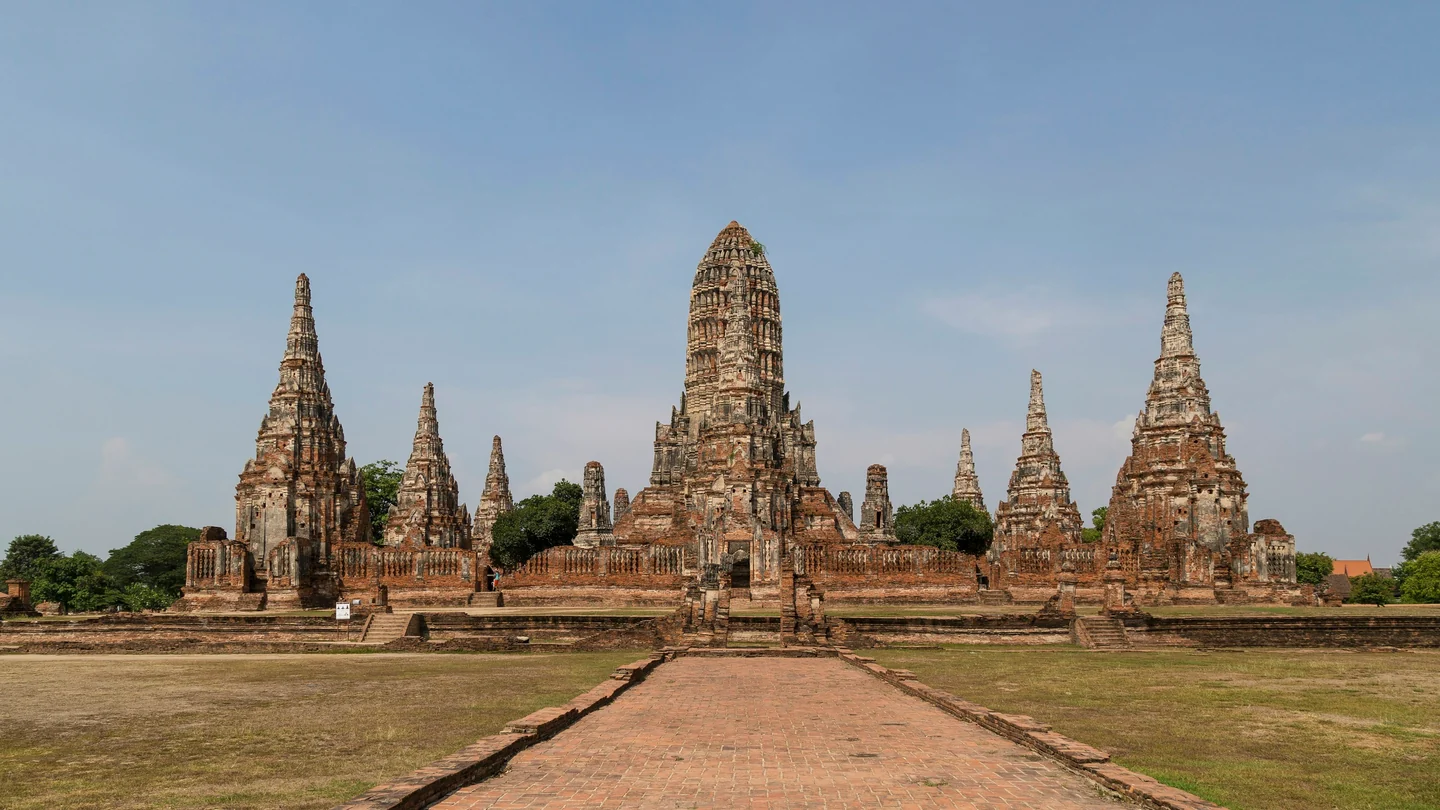
Wat Chaiwatthanaram stands on the west side of the Chao Phraya River, a royal temple King Prasat Thong built in memory of his late mother and known as a sunset spot. One travel writer calls it one of the most-photographed sunset spots in Thailand, with the classic shot taken from the opposite bank, and visitors describe crowds in rented traditional Thai costume posing against it — an April 2025 review places the costume-rental shops just across the street. Across the water from the old city, it is the one to save for the end of the day; to stay for the sunset, tell us before booking so we can agree the return time.
16Wat Yai Chai Mongkhon
Wat Yai Chai Mongkhon
Wat Yai Chai Mongkhon stands just outside the city to the south-east, its large chedi visible from far off; King Naresuan the Great had it built to mark his elephants' victory over the Burmese. Visitors climb the chedi for a view over the grounds and see long rows of saffron-draped Buddha statues and a reclining Buddha; one write-up makes it the first stop of its day.
17Wat Phanan Choeng
Wat Phanan Choeng
Wat Phanan Choeng stands on the south-eastern bank of the Chao Phraya River, in the outer city, and was built long before the Ayutthaya Kingdom was founded; inside is a revered golden Buddha and a Chinese shrine. An April 2025 review says visitors are taken with the big golden Buddha and feed the fish along the river bank, and calls it good for adults and children alike.
18Japanese Village
The Japanese Village, on the east bank of the Chao Phraya River south of the island city, keeps the site of Ayutthaya's old Japanese settlement as a memorial, opposite the Portuguese Village and next to the Dutch and British villages. Today it is a small museum building and a Japanese-style garden with displays and video presentations — a destination guide suggests about 30 minutes; a December 2024 review finds there is not much to see but is moved to stand where Japanese people once made their lives. It lies south of Wat Phanan Choeng, on the same bank of the river.
19Ayothaya Floating Market
The Ayothaya Floating Market is a built, retro-style recreation of an old Thai townscape around a pond near Wat Maheyong, with food and souvenir stalls, the odd cultural performance and short boat rides. An October 2025 review was underwhelmed: it found nothing really floating, only a few shops for clothes, food and snacks around the pond, and a deserted site on the Wednesday of its visit.
20Wat Maheyong
Wat Maheyong
Wat Maheyong, in Hantra sub-district, is a temple said to have been founded in 1438, with a bell-shaped chedi and a Chedi Chang Lom ringed at the base by 80 elephant figures; the floating market stands near it. It is still a working meditation centre — a write-up finds people in light white clothing on retreat, locals praying and leaving offerings, and a request for quiet — so it is a calm stop rather than a photo one.
21Wat Phra Ngam, the gate of time
Wat Phra Ngam
Wat Phra Ngam, in Khlong Sa Bua about 2 km north of central Ayutthaya, is a disused temple known for an old brick gate wrapped in the roots of a bodhi tree, which a tourism listing calls the 'door of time'. One travel writer finds the gate at its most striking at sunset, when the sun lines up almost straight through the opening; since the evening light is better saved for Wat Chaiwatthanaram across the water, this is one to catch earlier in the day.
22The river around the island
The old city sits inside a loop of three rivers, which is what makes it an island. An older tourism listing describes a sunset river cruise that takes in Wat Chaiwatthanaram and stops at others such as Wat Phanan Choeng. A boat, though, is your own arrangement, booked and paid directly with its operator — we neither sell nor book one — and where it starts and lands is something we confirm with you when you book.
23Bang Pa-In Royal Palace
Bang Pa-In Royal Palace lies about 17 km south of central Ayutthaya, down the Chao Phraya River — King Prasat Thong built it, and Rama IV and Rama V of the Bangkok dynasty later restored it as a summer palace. You walk among buildings in a mix of European and Thai styles: the Phra Thinang Wehart Chamrun, a Chinese-style throne hall; the Ho Withun Thasana tower, which you can climb; and the Aisawan Thiphya pavilion set in an ornamental pond. You cover the grounds on foot or by a hired golf cart. There is a dress rule — knees and shoulders covered, for men and women alike, or entry is refused. One write-up says most people come here first thing in the morning, before Ayutthaya; another warns that adding it to a day of five or six temples leaves you rushed and hot. On our day it is not a fixed add-on — ask us on WhatsApp or LINE before booking and we quote the changed itinerary separately; palace tickets are yours to buy.
24Wat Tako
Wat Tako
Wat Tako — styled 'Wat Tako (Luang Pho Ruay)' on its own site — is out in Don Ya Nang, in Phachi district. Visitors come to pay their respects to its revered monk and to pray for good luck, wealth and thriving businesses; a traveller's post calls the temple spacious, with photo spots and cafes. It is out in the province rather than on the loop, so send us your plan on WhatsApp or LINE before booking for a separate quote.
25Wat Satue
Wat Satue
Wat Satue stands on the bank of the Pasak River in Tha Ruea district, where its large reclining Buddha, Luang Pho To, lies out front beside the water. A French write-up says it draws crowds well off the usual tourist routes: at weekends thousands of Thais come to pray and lay gold on the Buddha, and a market runs at the temple every Sunday. Like Wat Tako, it is a trip out of town — tell us on WhatsApp or LINE before booking and we quote it separately.
26When to go: the cool months, the heat and the rains
November to February is the easy window: the cool-season guide from the Tourism Authority of Thailand calls central Thailand more pleasant then for strolling and cultural exploration, and names nearby Ayutthaya as ideal for a day trip. The rest of the year the sites are open-air and hot, so write-ups agree on the same advice — start early, to get ahead of both the heat and the crowds, and bring sunscreen, a hat and plenty of water. One guide puts the rainy season at June to October, usually short afternoon bursts with clear mornings; in a heavy monsoon some low-lying spots flood, which does not close the major temples but can affect access to a few, mostly in September and October. In early October 2026, during flooding in the province, the Culture Minister said the city island and its most important monuments were safe, with tourist sites and routes open and reachable as normal; the Fine Arts Department put flood protection in place at four monuments, Wat Chaiwatthanaram among them. Parents who went with a baby found the brick paths uneven and suggest a carrier over a stroller; for the temple halls, men and women alike cover knees and shoulders. If rain is in the forecast, our Bangkok rainy season transfer guide covers how rain can affect the drive out.
27Bangkok to Ayutthaya: the chauffeured day, the one-way drop, or a night by the river
Two ways to do it, and the choice comes down to where you sleep. Home the same evening? That is the chauffeured day at a flat THB 12,000 — one fare for the whole car that covers the run up from Bangkok, the shuttling between your agreed sites with the car waiting at each, and the drive back the same evening. You decide which sites and in what order, agreed with us before booking; nobody leads you round the ruins and no tickets or boats are sold, so the day stays yours to shape. Staying the night instead? The one-way drop runs a flat THB 7,000: the car takes you out to your Ayutthaya address and leaves you there; your stay and the return journey are separate. A riverside hotel such as Sala Ayutthaya on U-Thong Road, looking out over the water, is the kind of place it drops you. One travel writer makes the case for a night: the ruins lit after dark — though whether they are floodlit on your night is something we confirm with you when you book, since the floodlights at the flood-protected monuments came down in early October 2026 — and a quiet temple or two the next morning before you move on. Our Bangkok to Ayutthaya day trip guide walks one loop of four temples, with the etiquette and the riverside lunch stops.
28Bangkok hotels we publish pickup notes for
Pickup works from any address in Bangkok: the car comes to the door you give us. We publish pickup notes for a range of Bangkok hotels, among them The Siam Hotel Bangkok, The Sukhothai Bangkok, The Sukosol Bangkok, Chatrium Grand Bangkok and Lancaster Bangkok, each with its own pickup page.
29Как добраться
Время в пути · 60–90 мин
Door to door from your Bangkok hotel to the historical park; allow 90–120 minutes in the rush hour.
A private car takes you straight from your Bangkok hotel to Ayutthaya — about 80 km by road, 60–90 minutes off-peak, up the Don Mueang Tollway and then Asian Highway 1. It is one car from your door, with tolls and parking counted in a fare you know before the day.
Where is Ayutthaya — is it in Bangkok?
No — Ayutthaya is its own city, north of Bangkok, not a part of it. Its formal name is Phra Nakhon Si Ayutthaya, the name of both a district and a province, and the old city sits on an island ringed by three rivers.
How long do you need in Ayutthaya?
A write-up puts the minimum on-site time at 5 to 6 hours, and calls a whole day out of Bangkok the minimum for a satisfying visit. With only a morning or an afternoon, a destination guide's shorter route covers the main island temples. Another travel writer suggests staying the night — a quiet temple or two the next morning before moving on, and, on a night we confirm with you, the ruins lit after dark. By car you are back in Bangkok the same evening, or the one-way drop lets you stay over.
How old is Ayutthaya, and how did it fall?
Ayutthaya was founded in 1350 and was the capital of the Siamese kingdom for 417 years, until the Burmese army destroyed it in 1767. It has been on the UNESCO World Heritage List since 1991, and today the old city is an archaeological park of temple ruins.
How big is Ayutthaya?
The Fine Arts Department gives the protected area of the old city island as 1,810 rai — rai being the Thai unit of land. Its ruins are spread across that area, far enough apart that you need transport between them rather than your feet, which is what the car is for on the day.
Do you run Ayutthaya tours from Bangkok?
No. What most people call an Ayutthaya day trip, we run as a chauffeured day by private car: your own car and chauffeur to take you between the sites you choose and agree with us before booking, with no guide and no ticket sales on our side. Both fares — the chauffeured day and the one-way drop — are set out on this page.
THB 12,000 takes the whole car for the chauffeured day and has you back in Bangkok the same evening; THB 7,000 takes you out one way to stay the night. The chauffeur, tolls, parking and fuel come with either fare, and so do chilled water and private Wi-Fi on board. Book the one that fits; for Bang Pa-In Royal Palace, a temple out in the province or an airport pickup on the day, send us a message on WhatsApp or LINE before booking for a separate quote.